Guide · 2026
Bidet Seats for RVs and Off-Grid Bathrooms
By Ilane TallUpdated October 5, 2026Research-based
Best Bidet Seats is reader-supported. When you buy through our links we may earn a commission, at no extra cost to you. Commissions never change which products we recommend.
Shop for a bidet seat using any mainstream buying guide and you'll be pointed toward a $250 model with a heated seat, a wireless remote, and a tankless water heater that pulls over a kilowatt while it runs. None of that is useful advice if your toilet lives in a travel trailer, a converted van, or a cabin with a well and a propane water heater instead of a breaker panel. The entire premium end of this category is built around an assumption that doesn't hold off-grid: a wall outlet that's always live, and a water line that always delivers city pressure.
Pull that assumption out and the shopping list gets a lot shorter — and a lot more specific. This guide covers why electric seats fight your power system instead of working with it, how rig and well water pressure actually behaves compared with a municipal line, the real trade-off between a manual replacement seat and a clip-on attachment in a bathroom the size of a closet, how to winterize a bidet line before the rig goes into storage, and which three non-electric products we'd actually point you to. We'll also flag the handful of features that genuinely do need a standard, always-on household bathroom — so you're not left wondering what you gave up.
One honest note before we start: we don't run a testing lab and we haven't installed these units in a trailer ourselves. Everything below comes from comparing published specifications, current pricing, and how non-electric bidet hardware behaves as a category — read in the context of RV and off-grid water and power systems specifically.
The power problem
Why electric seats are a poor fit for shore power and generators
An electric bidet seat isn't a passive fixture — it's a small appliance, and like any appliance it needs power that's actually there when you reach for it. In a stick-built house that's a given. In a rig, it's conditional on three things all lining up at once: shore power being plugged in, a generator running, or an inverter pulling enough off the house batteries, and staying that way for the whole time the unit is installed, not just when you remember to flip a breaker.
Boondocking breaks that chain by design. You run a generator on a schedule — an hour or two in the morning, maybe again at dusk — specifically to conserve fuel, and the rest of the day the panel is dark unless the inverter is carrying the load off the battery bank. An electric seat with a heating element doesn't know or care about your generator schedule; its water heater and seat heater want to draw power continuously to stay ready, and a hybrid or instant heater pulls its heaviest draw in short bursts exactly when someone wants to use it — which may well be the hour the generator is off and the batteries are the only thing online. Even plugged into shore power at a campground, many pedestals are shared or amperage-limited, and a seat that's drawing hard the moment someone also starts the microwave is a nuisance you don't have at home.
There's also a quieter issue: standby draw. Electric seats with any kind of reservoir or seat heater stay warm around the clock by design, which is a rounding error on a home electric bill but a real, continuous drain on a battery bank that also has to run your fridge, lights, and water pump overnight. None of that is a dealbreaker if you're full-timing with a large solar and battery setup sized for it — but for a typical weekend rig or a basic off-grid cabin, it's current you'd rather spend elsewhere. That's the reason every product in this guide is non-electric: a mechanical attachment or seat draws nothing from the panel, ever, and works identically whether you're on shore power, running the generator, or three days into a stretch with neither.
The water problem
Water pressure on a rig or well versus municipal supply
A non-electric bidet has no pump of its own — it works exactly like a kitchen sprayer, pushed by whatever pressure is already in the line. That's precisely why this category of product is the right fit off-grid: it doesn't need a minimum PSI threshold or a particular flow rate to function, just enough pressure to push water through the nozzle. A trickle makes for a weak wash; anything close to normal cold-tap flow is plenty.
That said, "whatever pressure is in the line" behaves very differently depending on where the line is coming from, and it's worth understanding before you assume a bidet attachment will feel the same in a rig as it does at home. A municipal water line holds a steady pressure around the clock, typically regulated to stay within a fairly narrow band regardless of how many fixtures in the house are running. An RV on a campground's city water hookup is different on both ends: campground pressure varies wildly site to site and park to park, which is exactly why RVers run an inline pressure regulator between the hose bib and the rig — without one, a park with aggressively high pressure can stress fittings and seals never designed for it, bidet attachment included.
Off the hookup and running on the onboard tank, pressure comes from a demand pump instead of a static supply line. These pumps cycle on when you open a tap and off when pressure in the line reaches a set point, which means pressure at the nozzle isn't perfectly constant — it can dip briefly as the pump catches up, especially if something else in the rig (the shower, the kitchen tap) is drawing at the same moment. A private well behaves similarly in principle: a pressure switch cycles the well pump between a cut-in and cut-out point, so pressure at any fixture — including a bidet attachment — swings within that band rather than holding dead steady the way a municipal line does. None of this stops a non-electric attachment from working; it just means the wash can feel slightly less consistent than what you're used to on a home municipal line, and it's a reason to skip anything in this category marketed as needing strong, steady pressure to perform as advertised.
Fitting the bathroom
Manual seats versus clip-on attachments for a small RV bathroom
Both non-electric formats do the same core job, but they trade off differently in a bathroom measured in inches rather than feet, and the right call usually comes down to how much room you have and how your existing toilet is set up.
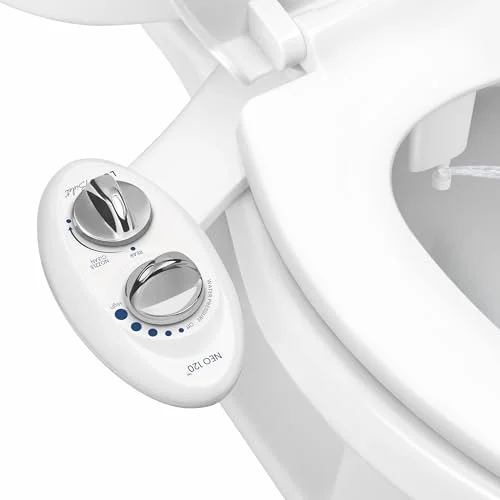
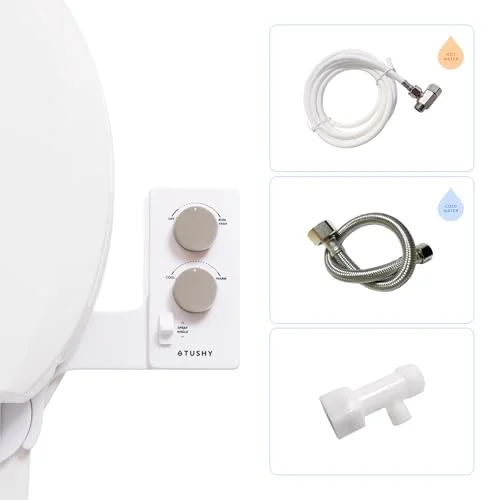
A clip-on attachment — the category the LUXE Bidet NEO 120 and the TUSHY Spa 3.0 both belong to — mounts between your existing toilet seat and the bowl, with the control dial or lever sitting off to one side where your hand can reach it. The advantage in a tight RV bathroom is that it doesn't touch the seat you already have, so there's no question of whether a replacement seat will clear a shower stall wall or a cabinet door that swings close to the toilet. The NEO 120 measures 17 x 10 x 3 inches, small enough to fit without reworking the space around it, which matters more in a rig than in a house where there's usually a few extra inches to spare on every side.
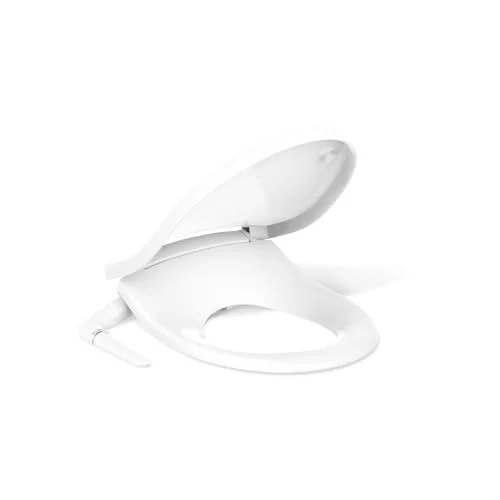
A full manual replacement seat — the format the Kohler PureWash M250 uses — swaps your entire toilet seat and lid for one with the spray mechanism built in, controlled by a side lever rather than a bolt-on dial. There's no attachment plate raising the sitting height, and nothing protruding from underneath that could catch on a cabinet door in a bathroom where every surface is close to another one. The M250 is built in a round bowl shape specifically, which is worth noting because a meaningful share of RV toilets use a round bowl rather than the elongated shape common in houses — check your bowl shape before ordering either way, since an elongated seat on a round bowl (or the reverse) won't seat correctly. It also has quiet-close hinges that won't slam in a rig where everything already rattles on washboard road, and quick-release hinges that let you lift the whole seat off in seconds, which is genuinely useful when you need clear access to clean around the bowl in a space too small to kneel beside.
If you're outfitting a guest or secondary bathroom and want the lowest-cost way to find out whether the whole idea suits rig life, the attachment is the lower-risk buy. If you're replacing a seat you were going to swap out anyway and you'd rather not have an extra lever bolted under the existing one, the manual seat is the tidier long-term answer.
Before storage
Winterizing a bidet line before storage
Anyone who's winterized an RV already knows the core principle: any line holding standing water is a line that can freeze, expand, and crack a fitting you won't discover until you dewinterize in spring and find a leak. A bidet attachment's supply line is no exception, and it's easy to overlook because it's small and tucked under the seat rather than running the length of the rig.
The sequence is the same one you'd use on any other fixture, applied to the T-valve and hose feeding the attachment specifically. Start by shutting off the water supply to the toilet at the valve, then open the bidet's control to release pressure and run the line as dry as you can. If you're blowing out the rig's plumbing with compressed air as part of your normal winterizing routine, make sure that pass includes the bidet's branch line and not just the main supply — it's a dead-end off the main line and easy for air to skip if you're not deliberately routing it there. If you're using RV antifreeze instead, run it through the bidet's valve the same way you would a faucet, until it runs through clean.
A few extra habits reduce risk further. Where it's practical, it's worth detaching an attachment like the NEO 120 or the TUSHY Spa 3.0 from the T-valve entirely for the storage season rather than leaving it connected — a short hose with no standing water in it can't crack from freezing, full stop, and reattaching takes a few minutes come spring. A manual seat like the PureWash M250 has less hose to deal with but still has an internal valve mechanism; running it dry and exercising the lever a few times after you've shut off and drained the water confirms there's no pocket of water left sitting in it. And if the rig or cabin sits through a hard freeze with any doubt about whether the line was fully drained, a quick pressure test before the first use of the season — supply on, watching the fitting for a weep — catches a cracked valve core before it becomes a mess.
Where this doesn't apply
What still needs a standard household bathroom instead
None of this is an argument that non-electric is simply the better choice everywhere — it's the right choice for the power and water constraints a rig or an off-grid cabin actually has. A handful of genuinely good features only make sense with an always-on outlet and a steady municipal line, and it's worth knowing what you're giving up so you're not left wondering later.
- A heated seat and continuously warm water. Both require power running around the clock or on demand at meaningful wattage — the kind of draw that's trivial on a home circuit and a real cost on a battery bank. If that comfort tier matters to you in a house or apartment, our cheapest electric bidet seat breakdown and our look at what changes between $150 and $250 cover what you get as the price climbs.
- A wireless remote and multiple pressure or position presets. These are electronic conveniences layered onto an electric unit's motor and controller — there's no manual equivalent, by definition. Lineups like the VOVO bidet seat lineup and the GAICOM bidet seat lineup show how that feature set is priced across a full electric range.
- A warm-air dryer. It's one of the more power-hungry add-ons on an electric seat and makes little sense to run off an inverter when you're already being deliberate about what draws current.
- A permanent, plumbed-in installation from a specialty or plumbing brand. If you're furnishing a fixed, full-time residence rather than a rig, it's worth comparing a dedicated bidet brand against a plumbing-brand option — our Delta Faucet vs the specialists comparison walks through that trade-off directly.
The practical takeaway: outfit the rig or the cabin with one of the three non-electric picks above, and save the electric shortlist for whichever bathroom in your life has a wall outlet that's live every single day.